

Latest News
March 05, 2026 | Commissioned tests, More tests
Advanced EDR test 2026: Padvish XDR
AV-TEST performed an extensive evaluation of Padvish XDR, concentrating on its Endpoint Detection and Response (EDR) capabilities, in November 2025. The goal was to measure the product's effectiveness in identifying and counteracting threats typically associated with advanced persistent threats (APTs). The assessment included comprehensive testing scenarios that emulated three different attack patterns based on the Kematian-Stealer, Bizfum-Stealer, and Helldown-Ransomware, each showcasing a variety of tactics and techniques used by sophisticated attackers.
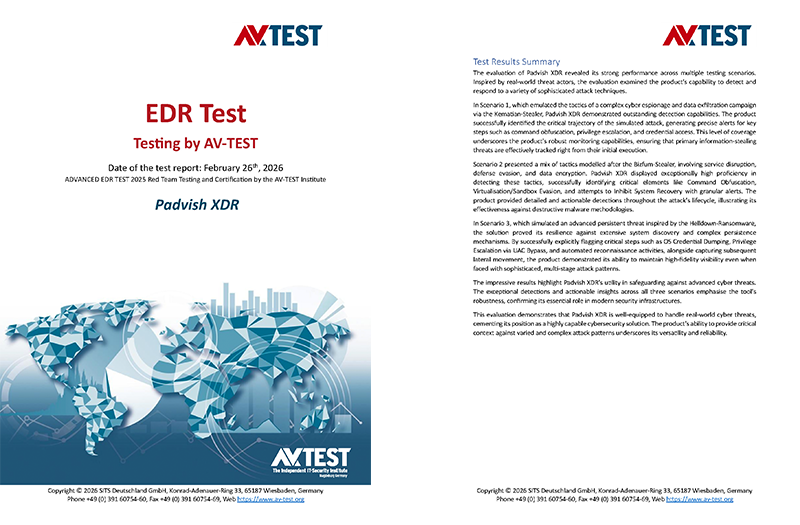
A test commissioned by Padvish
and performed by AV-TEST
Scenario 1 - Kematian-Stealer:
The first scenario involves a complex cyber espionage attack utilising PowerShell and extensive defence evasion. Progressing from an initial spearphishing attachment to comprehensive data collection and exfiltration, Padvish XDR demonstrated outstanding visibility. The product accurately detected critical stages like malicious file execution, command obfuscation, and privilege escalation via UAC bypass. Although explicit technique-level alerts were primarily replaced by telemetry for the final data archiving and exfiltration steps, high-quality detections for the preceding access and evasion phases provided the context needed to successfully track this evasive, multi-stage attack.
Scenario 2 – Bizfum Stealer:
This scenario replicates a targeted ransomware attack utilising phishing, defence evasion, and destructive payloads. Padvish XDR performed exceptionally well, detecting malicious executions, command obfuscation, and suspicious network communications. Critical impacts like data encryption, internal defacement, and attempts to inhibit system recovery were successfully flagged. The initial spearphishing attachment and complex sandbox evasions triggered comprehensive technique-level alerts. Although some final steps produced broader tactic-level warnings, the product maintained outstanding visibility into the primary attack vectors throughout.
Scenario 3 – Helldown Ransomware Emulation:
The final scenario emulates an advanced persistent threat, a modular attack using extensive system discovery, complex persistence, and evasion techniques to bypass standard detection. Padvish XDR successfully captured the initial spearphishing attachment and identified key subsequent phases, including malicious file execution, providing deep visibility into the later stages of lateral movement via RDP across the network. By explicitly flagging advanced manoeuvres such as OS credential dumping, privilege escalation, and COM hijacking, alongside monitoring automated system discovery activities and the impairment of security tools, the solution demonstrates a high degree of resilience.
Based on the findings across the simulated scenarios, including the cyber espionage, targeted ransomware, and advanced persistent threat emulations, Padvish XDR has demonstrated outstanding detection and visibility. The solution consistently identified critical attack vectors, from malicious file executions to sophisticated lateral movement and system impact activities. Consequently, the product has earned the prestigious AV-TEST Approved Advanced Endpoint Detection and Response (A2EDR) certification, signifying it as a trustworthy and effective solution in the field of cybersecurity.